

Reviewed · HISTORICAL TOURS
Buenos Aires: Historic District Private Guided Walking Tour
Buenos Aires’ political story comes together in a compact two-hour walk through the Historic District. You begin at Café Tortoni, then move through Plaza de Mayo, the Cabildo, Casa Rosada, and the Metropolitan Cathedral, with the city’s first subway station adding a surprising bit of urban history.
I like the tour’s private format, which gives you room to ask questions instead of following a large group. I also like that admission to both the Cabildo and Metropolitan Cathedral is included. The main caution is meeting-point communication: one booking went badly after a last-minute location change reached the customer through WhatsApp and email.
Key points at a glance
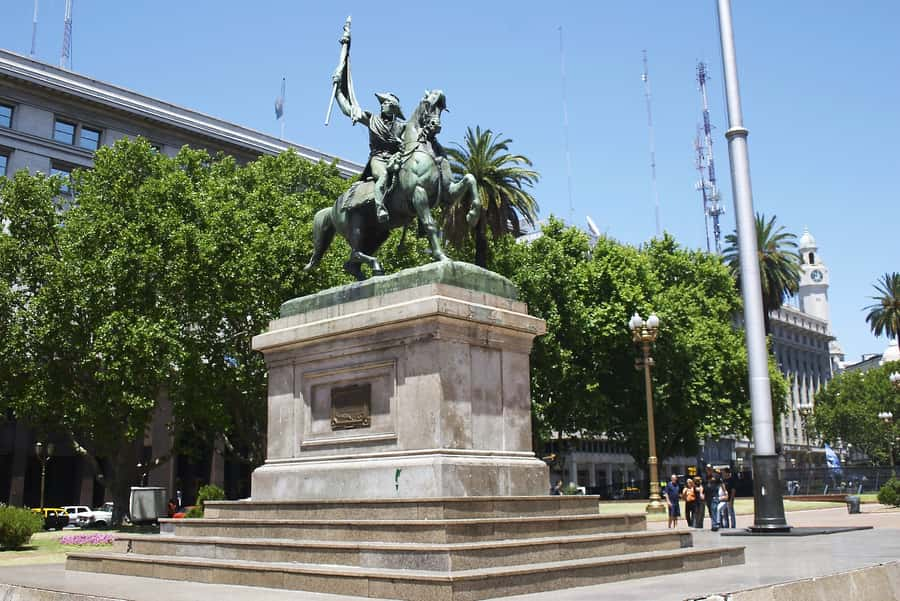
- Café Tortoni sets the scene: Begin outside one of Buenos Aires’ best-known cafés and hear about the historic figures who used it as a meeting place.
- Plaza de Mayo connects the city’s past and present: This is the site associated with the founding of Buenos Aires in 1580 and the location of major government buildings.
- The Cabildo gives colonial history a physical setting: You enter the former town council building, not just view it from the street.
- The Metropolitan Cathedral has an unusual neoclassical facade: Its design is different from the church exterior many visitors expect in Buenos Aires.
- The first subway station adds a modern layer: Near the cathedral, you see Plaza de Mayo station, where the city’s subway system began.
- Clear guiding is a major strength: Juan Manuel Sanchez has been praised for easy-to-understand English, strong historical explanations, and a friendly manner.
Starting outside Café Tortoni
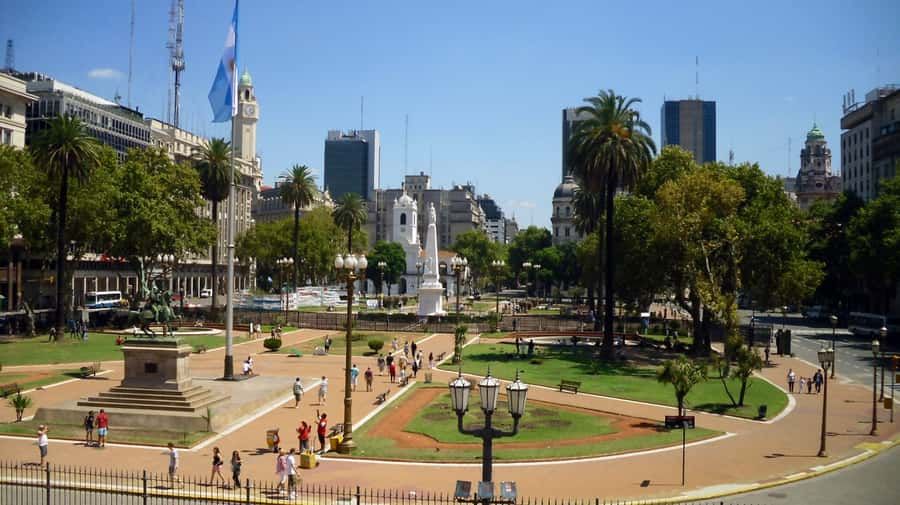
The tour begins outside Café Tortoni, a practical central meeting point with a story of its own. Your guide introduces the café as a gathering place for well-known figures from Argentine history, giving you an immediate sense that Buenos Aires’ past is tied to cafés, conversation, politics, and culture.
You do not begin with a long bus transfer or a complicated museum entrance. You meet your guide and start walking. That matters in Buenos Aires, where the distance between a grand civic building and a small historical detail can be only a few blocks.
The meeting point is easy to understand, but you should still arrive with the booking details available on your phone. Internet access is listed as something to bring, and that is worth taking seriously. One booking ended with the guest unable to reach the guide after the meeting point changed shortly before the start time. The issue was made worse by a need for WhatsApp and an SMS confirmation that could not be accessed.
That appears to have been an exception rather than the normal experience, but it is a useful warning. Check your email before leaving for the tour, keep your phone connected to the internet, and confirm the meeting point on the day. The tour does not include hotel pickup or drop-off.
More Historical Tours in Buenos Aires
- Nazis in Buenos Aires: a historical walking tour
★ 4.9 · 193 reviews - San Telmo: Historical Guided Tour with Street Food & Drinks
★ 5.0 · 87 reviews - Buenos Aires: La Boca Art and History Walking Tour
★ 4.8 · 55 reviews
Plaza de Mayo and the making of Argentina
From Café Tortoni, the walk heads toward Plaza de Mayo, the central historical stop. The square is tied to the founding of Buenos Aires in 1580, so this is where the guide can place the city’s story on a clear timeline.
You will hear about Argentina’s independence, major political events, and national traditions. The value here is not simply seeing a large plaza. It is understanding why the buildings around it matter and how Buenos Aires became the country’s political center.
The square also works well for first-time visitors because several important sights are close together. You can look across the open space and connect the presidential office, the old colonial council building, and the cathedral as parts of one civic center.
I would pay attention to the guide’s explanation of the buildings rather than rushing through photographs. The tour is short, and Plaza de Mayo can easily become a quick stop where you take a picture and move on. A good guide helps you read the square as a place of government, religion, colonial administration, and national memory.
You are also promised panoramic city views from one of Buenos Aires’ most picturesque neighborhoods. The exact viewing point is not specified, so you should not book this as a dedicated skyline lookout. Think of the views as part of the walk, with the open plaza and surrounding architecture providing the main visual reward.
Casa Rosada and the power of the square
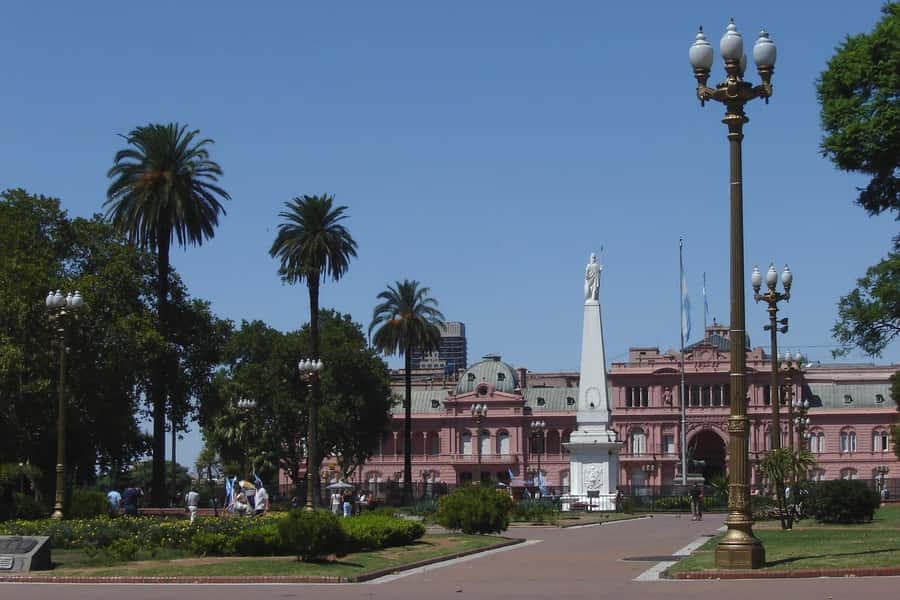
Casa Rosada, the Argentine president’s office, is one of the main sights around Plaza de Mayo. The tour gives you a chance to see the building in its civic setting and hear why this address matters to Argentina’s political life.
The strength of a private walk here is the ability to ask simple questions. You might want to know how the presidential office fits into the wider story of independence, how the square has been used over time, or why this particular part of Buenos Aires became the center of national government.
The exterior is the key experience described for Casa Rosada. Do not assume that this booking includes a tour of the presidential offices. The stated inclusions cover entrance to the Metropolitan Cathedral and Cabildo, but not an interior visit to Casa Rosada.
That distinction helps you set the right expectations. You are booking a guided look at the historic district and its institutions, not a full presidential palace tour.
Inside the Cabildo, Buenos Aires’ colonial council
The Cabildo offers the clearest link to the colonial period. It once served as the seat of the town council, making it a useful counterpoint to Casa Rosada’s modern political role.
You enter the building as part of the tour, and admission is included. That is important because the Cabildo is not just another facade on a walking route. Its former function helps explain how the city was administered before Argentina became an independent nation.
I like this stop because it gives the history a human scale. A plaza can feel abstract, but a council building shows where local decisions were made. Your guide can connect the building to the larger themes of colonial rule, independence, and the growth of Buenos Aires.
The Cabildo is also a good reason to choose this tour instead of simply walking around Plaza de Mayo on your own. You can see the building without paying a separate entrance fee, and the guide supplies the context that signs and guidebooks may leave scattered.
The tour description does not specify how long you spend inside or which rooms are open on the day. Allow the guide to set the pace. Since the full walk lasts only two hours, the Cabildo visit is likely a focused introduction rather than an exhaustive museum visit.
More Walking Tours in Buenos Aires
- Buenos Aires Hop-On Hop-Off Bus, Free Walking Tours & Discounts
★ 4.5 · 2,218 reviews - Buenos Aires: La Boca Guided Walking Tour in English
★ 4.8 · 1,587 reviews - Buenos Aires: Personalized 2 to 8-Hour Private Walking Tour
★ 4.7 · 149 reviews - Buenos Aires: San Telmo and Market Guided Walking Tour
★ 4.8 · 102 reviews
The Metropolitan Cathedral’s unusual neoclassical design
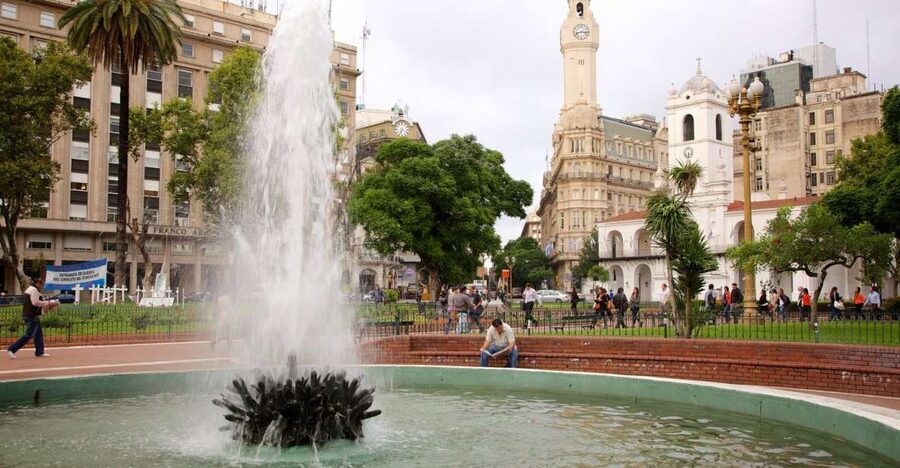
The next major stop is the Metropolitan Cathedral. Its neoclassical exterior is described as unusual, and that is a useful point to keep in mind. Many visitors expect a church facade to signal its religious purpose at once. Here, the building’s classical appearance gives it a different character from the more immediately ornate churches you may see elsewhere.
Admission is included, so you can go inside rather than viewing only the front. The guide can explain the cathedral’s place beside Plaza de Mayo and in the wider civic center.
I would treat this as an architecture and setting stop as much as a religious one. The cathedral is near the presidential office and Cabildo, so three different kinds of authority appear within the same short walk: government, colonial administration, and the church.
The description does not promise a religious service, special ceremony, or extended interior commentary. You should expect a guided visit to the building, with the unusual neoclassical design as the main point of interest.
For visitors who prefer to keep walking time efficient, this is a strong arrangement. You do not need to spend a separate morning seeking out the cathedral. It fits naturally into the route and adds variety after the government buildings.
Buenos Aires’ first subway station
Near the cathedral, you see Plaza de Mayo subway station, identified as the place where Buenos Aires’ subway system began. This is a small detail, but it helps prevent the tour from becoming a procession of only grand historic buildings.
The station brings the city’s modern growth into the story. After hearing about colonial government and independence, you get a reminder that Buenos Aires also developed as a major modern city with its own underground transport system.
The station appears to be viewed as part of the route, not entered as a separate attraction. You should expect an exterior look and an explanation from the guide rather than a subway ride or transport-focused tour.
I like this kind of stop because it takes very little time but gives the walk a wider range. The Historic District is not frozen in the colonial era. Its streets connect early settlement, national government, religious life, and modern infrastructure.
How the private format changes the experience
This is a private-group tour, so your guide can respond to your interests more easily than on a large scheduled walk. If your group wants more help with political history, the guide can focus there. If architecture interests you most, you can ask about the Cabildo and cathedral.
The strongest guide feedback names Juan Manuel Sanchez. He has been described as clear and easy to understand in English, personable, and willing to answer questions and comments. Another booking names Juan Miguel as professional and especially effective at explaining basic Argentine history while visiting the central buildings and squares.
There are also positive comments about Juan Manoel, who was described as doing more than expected and helping the group feel comfortable. The spellings differ across the booking records, so I would not assume these names refer to one person. The practical point is that the guide experience may vary by assignment, while the most praised qualities are clear English, strong historical explanations, friendliness, and flexibility.
The listed guide languages are English, Portuguese, and Samoan. If language comfort matters to you, select or confirm your preferred option during booking. The information does not state that every guide speaks all three languages.
Is $52 good value for two hours?
At $52 per person, this is not the cheapest way to walk around Plaza de Mayo. You can see the main square and many exteriors without paying for a guide. The price makes more sense if you want a private explanation, included entry to the Cabildo and Metropolitan Cathedral, and a short route that covers several major subjects in one sitting.
The value is strongest for a first visit. Argentina’s independence, colonial administration, presidential government, religious institutions, and subway history can feel like separate facts when you encounter them alone. A guide gives you a sequence that makes the city easier to understand.
The private format also matters more if you are traveling as a small family or group with different questions. You are paying for attention, not just admission. If you already know Buenos Aires’ political history and prefer to set your own pace, the price may feel high for a two-hour walk.
There is no hotel transfer included, so you also need to get yourself to Café Tortoni. That is normal for a central walking tour, but it means the total cost is not the full door-to-door cost of an organized excursion.
Practical details before you book
Wear comfortable shoes. The experience lasts two hours and takes place on foot, with several outdoor stretches between the major buildings.
The tour is listed as wheelchair accessible. If you use a wheelchair, it is still sensible to confirm the access arrangements for the Cabildo and cathedral at the time of booking, since the available details do not describe entrances, ramps, or interior routes.
You can cancel up to 24 hours before the start for a full refund. The reserve-now, pay-later option lets you hold a place without paying immediately, which is useful when your Buenos Aires schedule is still changing.
The activity offers skip-the-ticket-line access. That can save time at the included sights, though it does not remove the need to arrive at the correct meeting point on time.
The overall rating is 4.7 from nine bookings, with strong marks for the guide’s clarity and historical explanations. One serious service problem involved a changed meeting point and failed communication, so I would make phone access part of your preparation rather than treating it as an afterthought.
Who should choose this historic district walk?
I would recommend this tour to first-time visitors who want a clear introduction to central Buenos Aires without committing half a day. It suits anyone who likes to connect buildings with political and social history rather than simply collect photographs.
It is also a good fit for families or private groups that want to ask questions at their own pace. The two-hour length is manageable, and the route includes enough variety to keep the walk from feeling like a single-square sightseeing stop.
History-minded visitors will get the most from the Cabildo, Plaza de Mayo, and Casa Rosada. Architecture fans will appreciate the cathedral’s unusual neoclassical design. Urban-history enthusiasts will enjoy the subway station detail.
I would hesitate if you want a long museum visit, a presidential palace interior tour, or a full-day exploration of Buenos Aires neighborhoods. The route is focused on the Historic District, and the supplied details do not include tango, food tasting, hotel transport, or additional areas beyond this central walk.
Should you book it?
Book this tour if you want a short, private introduction to Argentine history with entry to the Cabildo and Metropolitan Cathedral included. The clearest benefit is the guide’s explanation of why Plaza de Mayo and its surrounding buildings matter, and Juan Manuel Sanchez has received especially strong praise for clear English and thoughtful answers.
Skip it if you are comfortable researching the area yourself or want a slower, more detailed museum experience. If you book, wear good shoes, bring internet access, and check for any meeting-point update before leaving. Those simple steps protect the main benefit of the experience: two focused hours that give Buenos Aires’ historic center a coherent story.
FAQ
Where does the tour meet?
The meeting point is outside Café Tortoni.
How long does the walking tour last?
The tour lasts two hours.
What sights are included?
The route includes Plaza de Mayo, Casa Rosada, the Cabildo, the Metropolitan Cathedral, and Plaza de Mayo subway station.
Is admission to the Cabildo included?
Yes. Entrance to the Cabildo is included.
Is entrance to the Metropolitan Cathedral included?
Yes. Entrance to the Metropolitan Cathedral is included.
Is hotel pickup provided?
No. Hotel pickup and drop-off are not included.
What languages are available?
The listed guide languages are English, Portuguese, and Samoan.
Can I cancel for a full refund?
Yes. You can cancel up to 24 hours before the tour for a full refund.
Just added around Buenos Aires
- Tango Show at El Querandi with optional Dinner★ 4.2 · 3 reviews
- Wine Tasting in Buenos Aires★ 4.2 · 4 reviews
- Walking Tour: Buenos Aires bookstores★ 4.3 · 12 reviews
- Velez Sarsfield Football Match★ 5.0 · 3 reviews
- Unique Tigre and Delta Private Day Cruise Navegation★ 5.0 · 3 reviews
- Private Underground Tango Immersion★ 5.0 · 31 reviews
- Sailing with Wine Tasting in Buenos Aires★ 5.0 · 50 reviews
- Experience The Essence of Buenos Aires in San Telmo★ 5.0 · 51 reviews
Historical Tours, compared.

Nazis in Buenos Aires: a historical walking tour
Read our review →

Historical Guided Tour with Street Food & Drinks
Read our review →

Recoleta Cemetery – Small Group Tour of History & Secrets
Read our review →


Browse the lists this tour appears in